






Origins, History and Techniques of Black Light Theatre | HILT Prague
How Black Light Theatre Began and How It Works
Black light theatre is widely recognised today as a distinctive Czech theatrical phenomenon, but the visual principles behind it are much older and more international. Its development combines the black cabinet illusion, puppetry, shadow theatre, early cinema, avant-garde stage experiments and, later, ultraviolet and luminescent technology.
What Prague artists achieved in the late 1950s and early 1960s was not simply the invention of one stage trick. They transformed several older techniques into a complete theatrical language capable of carrying an entire performance through movement, music, illusion, choreography and visual storytelling.
A legend from ancient China
One of the best-known legends connected with black light theatre tells of the Chinese emperor Wang-Pang, whose beloved son Liang died. According to the story, a court magician named Mang-ti promised to bring the young man back to life. Hidden assistants dressed in black manipulated the prince’s figure in dim light, allowing the grieving emperor to believe that his son could move and speak with him once again.
Or so the legend says.
This story should not be treated as documented history. Its importance lies in the image it creates: a visible figure appears to live because the people controlling it disappear into darkness. That same poetic principle remains at the heart of black light theatre today.
Asian puppetry and shadow traditions
Chinese shadow theatre used candlelight or lamps to project silhouettes onto a translucent screen. Japanese Bunraku developed a different but related convention: large puppets are manipulated by several visible puppeteers, traditionally dressed in black. The audience accepts the manipulators as neutral and concentrates its attention on the puppet.
Bunraku is not the same technique as modern black light theatre, and it would be too simple to describe it as a direct ancestor. Nevertheless, both traditions demonstrate a fundamental theatrical idea: the performer can deliberately withdraw from the spectator’s attention so that an object, puppet or figure appears to acquire a life of its own.
The black cabinet illusion in Europe
In Europe, the illusion later became known as the black cabinet. A stage, its curtains and the performers’ costumes are covered in deep black material. Carefully directed light reveals only selected objects or figures, while the black-clad manipulators merge with the background.
The Munich actor and stage director Max Auzinger is often credited with popularising this principle in European illusion theatre during the late nineteenth century. Early filmmakers, including Georges Méliès, also used disappearing performers, dark backgrounds, substitutions and other related visual tricks to create impossible images before digital effects existed.
The black cabinet also appeared as a special technique in dramatic productions. However, it was usually used only for individual scenes or brief effects rather than as the foundation of an entire evening.
Georges Lafaye and the French avant-garde
A major step came in the early 1950s through the work of the French puppeteer and visual artist Georges Lafaye. He explored the dramatic possibilities of objects, shapes and costumes moving independently against darkness. Instead of using the black cabinet only as a magician’s trick, he treated it as a complete visual language.
His work influenced Czech puppeteers. In 1957, members of the Salamandr group, then connected with the Spejbl and Hurvínek Theatre, used black theatre techniques in Czechoslovakia. Their experiments inspired a generation of Czech theatre artists during the following years.
The Czech birth of modern black light theatre
At the turn of the 1960s, Czech artists developed the technique into full theatrical productions. Among the important early personalities were Josef Lamka, Hana Lamková, Jiří Srnec and other puppeteers, directors, designers and performers who created their own companies and artistic approaches.
Prague gradually became the international centre and world home of the genre. Czech companies travelled extensively, and their performances could be understood without translation because they communicated through movement, objects, music, mime and visual transformation.
After the Velvet Revolution of 1989, black light theatre experienced a major commercial and artistic boom. For many years, approximately ten companies operated in Prague. After the Covid-19 pandemic, four permanent black light theatres remained active in the city.
Black theatre and luminescent theatre are not identical
A frequent misunderstanding is that black light theatre has always depended on ultraviolet light. In fact, the original black cabinet technique did not require UV lamps or fluorescent paint. It relied on black fabric, total control of stray light and narrow beams directed only at the objects that the audience was meant to see.
Luminescent theatre developed as a related but distinct branch. Czech visual artist and director František Tvrdek experimented with materials that glowed under ultraviolet light and eventually developed an extensive palette of luminescent colours. His work gave objects and puppets a vivid spectrum that could appear to shine from within.
Over time, the two approaches began to merge. Contemporary black light theatre may combine the traditional black cabinet, front and side lighting, ultraviolet lamps, fluorescent costumes, shadow theatre, projection, dance and multimedia. The technique is therefore not one fixed formula but a family of visual methods.
How the illusion works
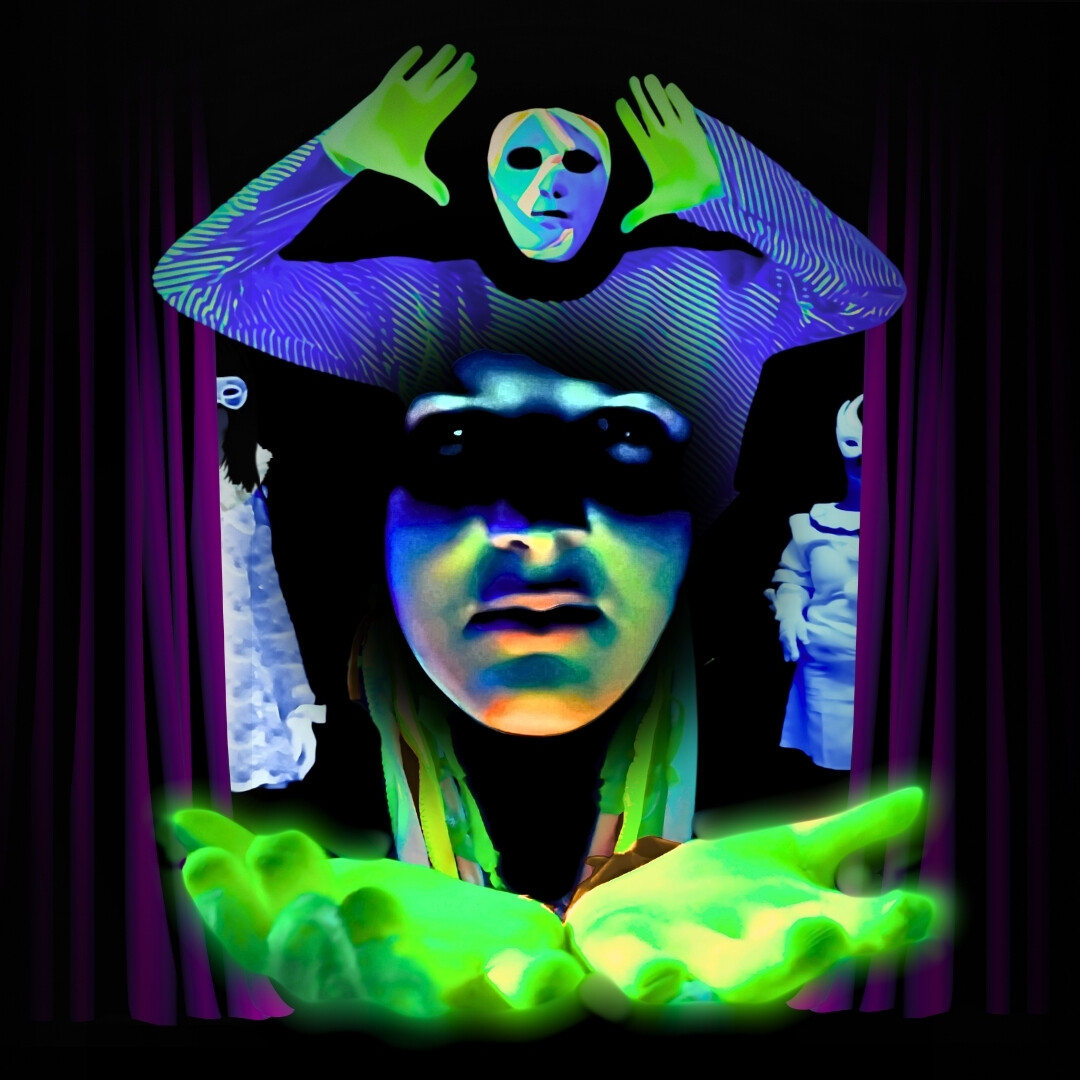
The audience sees only what the lighting designer allows it to see. Black-clad performers move through carefully controlled darkness, manipulating costumes, masks, puppets and scenery. An object may float, divide, disappear, transform into a human figure or move through the auditorium.
The effect may look effortless, but it demands exact choreography, spatial memory, teamwork and safety. Performers often work without seeing one another clearly. A single misplaced hand, beam of light or reflective surface can reveal the mechanism and break the illusion.
Technology can support the magic, but it cannot replace theatrical imagination. A collection of fluorescent objects is not automatically a performance. Black light theatre becomes art only when visual effects serve rhythm, emotion, character and story.
Black light theatre in the twenty-first century
Today, the genre can range from intimate puppetry to dance theatre, interactive performance and large multimedia productions. Modern projections and digital images offer new possibilities, but the essential fascination remains unchanged: the spectator watches a real human performer create an impossible image only a few metres away.
HILT Black Light Theatre Prague continues this tradition through modern dance, shadow theatre, film, live performance, audience interaction and UV projection. Projected images can merge with living performers so closely that spectators gradually lose certainty about what is physical and what is digital.
HILT does not seek to preserve black light theatre as a museum exhibit. It respects the historic principles of the genre while developing them for contemporary audiences.
“You have to enter the darkness to see the light.”
Continue with the complete history of Prague black light theatre
This page explains the origins, techniques and artistic principles of the genre. For the complete story of Prague’s black light theatre companies, their personalities, rivalry, development, the original WOW 3D Stage Show and the creation of HILT, continue with:
Interview with Theodor Hoidekr on the Living History of Prague Black Light Theatre
The long-form interview combines documented theatre history with the first-hand testimony of HILT founder Theodor Hoidekr, who participated in the creation of WOW and later established his own independent company.
Further historical context: World Encyclopedia of Puppetry Arts – Black Theatre | VisitCzechia – Black Light Theatre: A Czech Phenomenon