






 The Magic of Shadows
Horazio Beneš in conversation with Theodor Hoidekr on the living history of Prague black light theatre.
This interview combines documented theatre history with the first-hand testimony of Theodor Hoidekr , who participated in the creation of the original WOW production and later founded HILT Black Light Theatre Prague. The interview is conducted by Horazio Beneš.
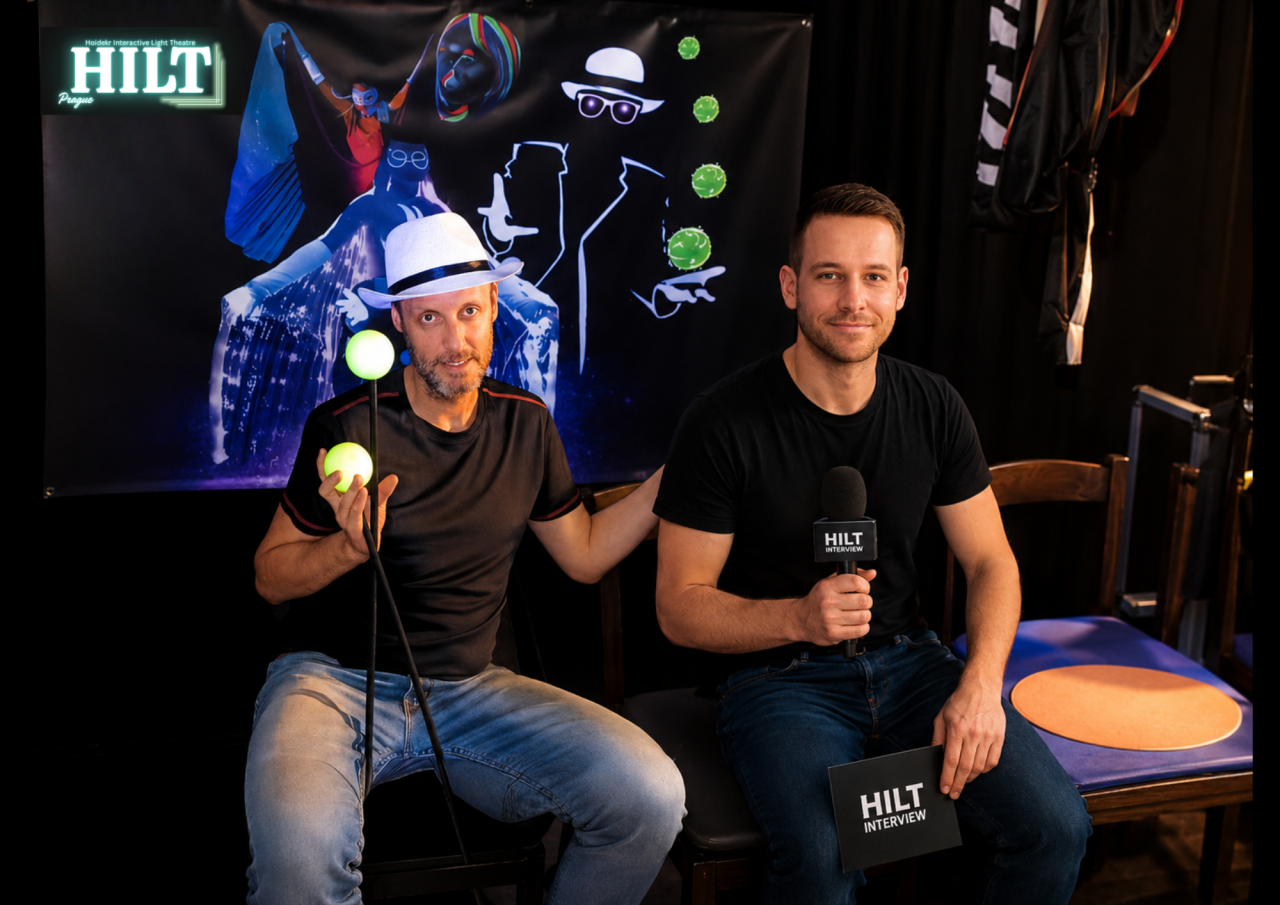
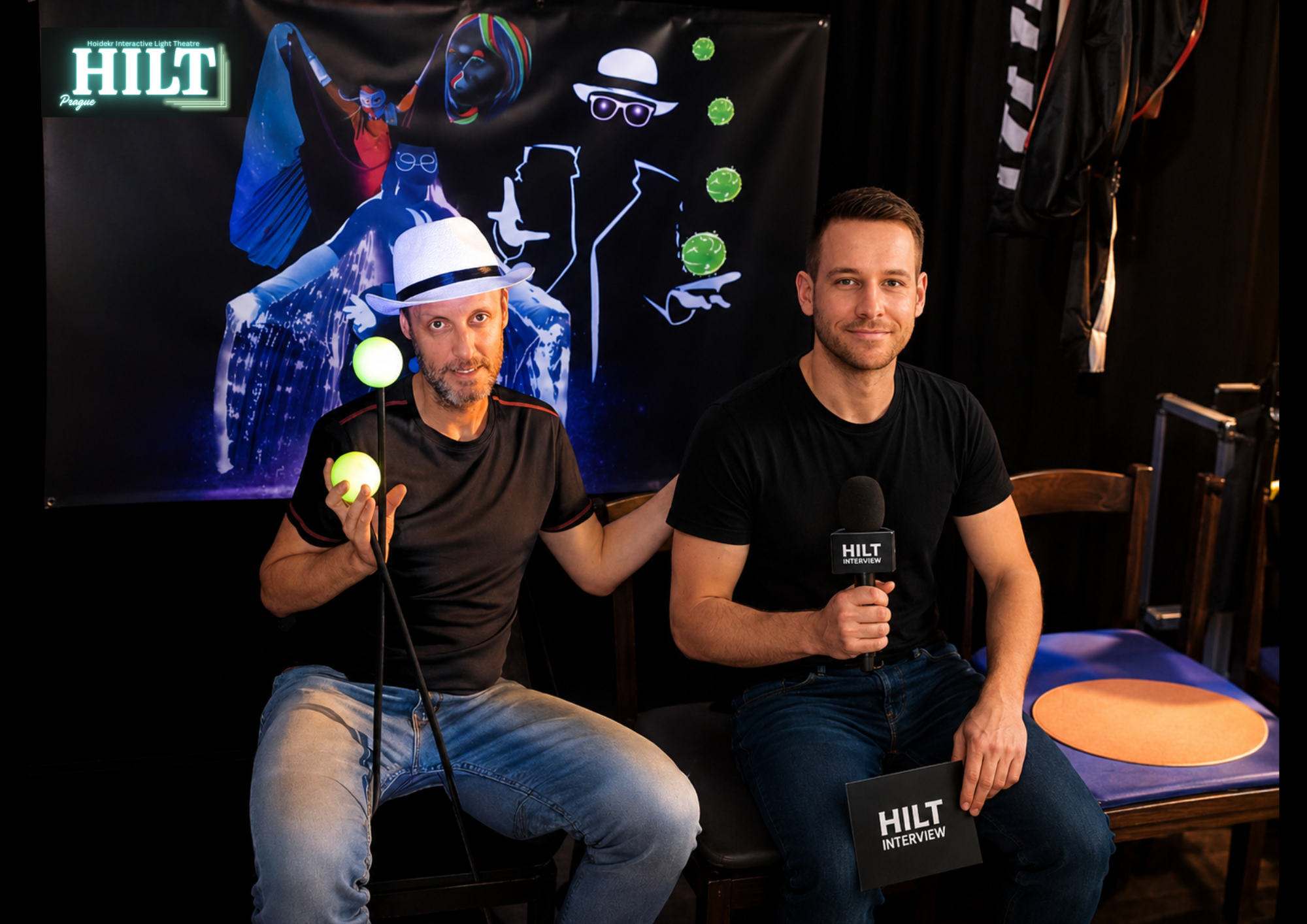
Horazio Beneš: Welcome, dear readers. My name is Horazio Beneš, and I work in the production field of black light theatre. Today, however, I will not be speaking about daily theatre operations. I have invited Theodor Hoidekr, director, playwright, choreographer and founder of HILT Black Light Theatre Prague, to guide us through the fascinating history of this magical theatrical genre. Welcome, Theodor.
Theodor Hoidekr: Thank you, Horazio. I am very happy that we are discussing black light theatre not merely as a tourist attraction, but as a living Czech theatrical tradition with a rich, dramatic and sometimes surprisingly complicated history.
Prague: the world home of black light theatre
Horazio Beneš: Let us begin with the present. How many permanent black light theatres are active in Prague today?
Theodor Hoidekr: After the Covid-19 pandemic, four permanent black light theatres remained active in Prague: HILT, WOW Show, Image Theatre and Black Light Theatre Jiří Srnec.
Before the pandemic, and especially during the boom that followed the Velvet Revolution of 1989, there were many more. For years, Prague was home to around ten different companies and productions.
Prague is still recognised internationally as the world base and home of black light theatre. This is not merely a phrase invented by one theatre for advertising. It is how the genre is perceived by audiences, festival organisers and cultural agencies around the world.
When a Czech black light theatre company is invited abroad, the organisers usually want a company from Prague because they see Prague as the original cultural centre of this genre. Black light theatre companies have since appeared in many other countries, but Prague remains its best-known home. (VisitCzechia: Black Light Theatre, a Czech phenomenon)
What exactly is black light theatre?
Horazio Beneš: What makes black light theatre different from ordinary theatre?
Theodor Hoidekr: Its foundation is the so-called black cabinet. The stage is surrounded by material that absorbs light. Performers dressed completely in black become invisible, while illuminated objects, costumes and actors appear to float, disappear, transform or move independently through space.
But the technique alone is not enough. A successful performance also requires choreography, rhythm, music, mime, acting, precise lighting and absolute trust between the performers. In complete darkness, one wrong step can disturb an entire illusion.
Black light theatre therefore combines craftsmanship with imagination. The audience may see a flying object for only a few seconds, while behind it there can be several people moving in exact coordination.
The roots of the black-cabinet principle can be traced through Asian puppetry, illusionism, early cinema and European theatrical experiments. The specific Czech form, however, developed during the late 1950s and early 1960s and became an important cultural export of Czechoslovakia.
The early history was already marked by strong personalities, artistic divisions and competition. Companies protected their performers, effects and technical knowledge. That tradition of secrecy and rivalry continued for decades. The Theatre Institute’s research describes both intense competition over the name “black light theatre” and the tendency of companies to protect their own artistic identity and know-how. (Roman Vašek: Black Light Theatre and Enterprise in Ballet, Institute of Arts – Theatre Institute, 2020)
Prague black light theatres: a reverse timeline
Horazio Beneš: Could you give us an overview of the main Prague black light theatres, beginning with the newest?
Theodor Hoidekr: Certainly. Some exact closing dates are difficult to establish because several companies gradually stopped performing rather than formally announcing their end. But the main historical line is approximately as follows:
- HILT Black Light Theatre Prague
Artistic origins in 2006; first public performance in August 2007 – present. - National Black Light Theatre Prague
Founded in 2004 – later closed. - WOW Black Light Theatre / originally WOW 3D Stage Show
Premiere on 7 February 2002 – present. - Divadlo Bohemia
Founded in 2002 – short-lived. - Frankenstein Comedy 3D by All Colours Theatre
Created after WOW left the former Jiří Grossmann Theatre – short-lived. - Černé kreslené divadlo Františka Kratochvíla / Divadlo Metro
Established in its post-revolution form in 1990 – continued for many years; it is no longer counted among Prague’s four permanent post-Covid black light theatres. - All Colours Theatre / later Černé divadlo Praha
Around 1990 – its regular black light theatre activity ended in 2019. - Ta Fantastika Black Light Theatre Prague
Returned to Prague around 1990 and opened its permanent Karlova Street venue in 1993 – black light theatre operations ended in 2020. - Divadlo Imaginace
Developed from Jiří Srnec’s experimental Imaginativ company in the early 1990s – later closed. - Image Theatre
Founded in 1989 – present. - Black Light Theatre Jiří Srnec
Founded in 1961 – present.
These were not interchangeable productions. Every company developed its own visual language. Image became strongly associated with dance and acrobatics. WOW emphasised movement, large visual effects and spectacle. Metro developed the patented technique of animated lines. Ta Fantastika combined black light theatre with other commercial theatrical forms. HILT developed its own intimate, interactive and experimental style.
The 1990s were an extraordinary period. Around ten companies operated in Prague, some playing two or even three performances a day. The sector was commercially attractive, but it was also intensely competitive. (Institute of Arts – Theatre Institute research)
HILT: an idea born before the company had a name
Horazio Beneš: Let us now begin the journey backwards with HILT. When exactly was it founded: in 2006 or in 2007?
Theodor Hoidekr: Both years are important, but they describe two different moments.
In 2006, while I was still working at WOW, I began writing my first independent black light theatre script for a project called Magic Light Show. At that time, I did not yet know that I would actually leave WOW the following year.
A small circle of friends and colleagues had already begun meeting privately. We were people for whom black light theatre was not simply employment. We genuinely loved the genre and wanted to explore what we could create independently.
The artistic idea of the company therefore began in 2006.
However, we only chose the name HILT – Hoidekr Interactive Light Theatre shortly before our first public appearance. HILT officially entered public life with its first performance in New Delhi, India, in August 2007.
For that reason, I describe 2006 as the birth of the idea and the first script, while August 2007 represents the official public beginning of HILT.
A theatre company, not an artificial production
Horazio Beneš: What did you want HILT to represent?
Theodor Hoidekr: I did not want to create another anonymous production assembled only to sell tickets. I wanted a genuine theatre ensemble.
HILT grew without major sponsors, wealthy investors or comfortable financial protection. We had to become self-sufficient artists. We created the performances, rehearsed them, produced them, promoted them, travelled with them and often physically built the stage ourselves.
This independence was sometimes difficult, but it gave us artistic freedom.
From the beginning, Štěpánka Pencová and I tried to build the company on equality and mutual respect. We did not want rivalry, career games or performers trying to destroy one another to gain a larger role. Naturally, a theatre needs leadership and discipline, but it also needs trust.
Members of Prague black light theatres traditionally work almost exclusively for one company at a time. This is partly because each theatre protects its technical secrets and artistic style. The Theatre Institute even noted that HILT and WOW were unusual because we occasionally maintained basic cooperation despite belonging to a strongly competitive environment. (Institute of Arts – Theatre Institute research)
HILT has always refused to participate in the battles between Prague’s black light theatres. That does not mean we were untouched by them. Once we entered the permanent Prague theatre scene, we became part of that competitive world whether we wanted to or not.
But I never wanted HILT to gain attention by attacking another company. I wanted our work to speak for us.
Innovation instead of preserving a museum
Horazio Beneš: How is HILT artistically different?
Theodor Hoidekr: We respect history, but we do not want to preserve black light theatre as a museum exhibit.
The world changes. Audiences change. Technology changes. Theatre must respond without losing its soul.
Over the years, HILT has combined black light theatre with live singing, modern dance, shadow theatre, film, audience interaction and multimedia projection.
One of our latest directions is the integration of UV projections with live black light theatre. These are not ordinary films projected behind performers. The projected scenes use black backgrounds and fluorescent visual elements that resemble the real stage language of black light theatre.
A projected figure can therefore transform into a living performer, or a live character can disappear into a projected world. The audience gradually loses certainty about what is real and what is digital.
That uncertainty is deliberate. When the spectator stops analysing the mechanism and simply accepts the illusion, black light theatre becomes magic again.
HILT is publicly described as one of Prague’s younger and more innovative companies, characterised by dynamic choreography, modern technology, shadow theatre and direct audience interaction. (VisitCzechia: Black Light Theatre in Prague)
From Magic Phantom to Images of Love
Horazio Beneš: What performances shaped the recent history of HILT?
Theodor Hoidekr: For many years, our successful main production was Magic Phantom, later known simply as Phantom. It brought together scenes and theatrical ideas developed during different periods of HILT’s history.
Magic Phantom was performed according to a different weekly schedule than the one we use today.
As HILT began receiving more invitations for tours, private performances, corporate events and regional theatres, Saturdays became especially important for travel and special engagements. We therefore reorganised the entire Prague programme.
Our current production is Images of Love, which premiered on 11 October 2024.
The show follows different forms and phases of love: the first meeting, excitement, romance, nightlife, dreams, temptation, fear, routine and the struggle to preserve intimacy. Film projections transform into live black light theatre scenes, while the audience is sometimes drawn directly into the atmosphere.
The performance lasts approximately 70 minutes without an interval and is entirely non-verbal. It can therefore be understood by audiences of every nationality.
Images of Love was also presented in India at the Bharat Rang Mahotsav 2025 festival and received two awards. (HILT: Images of Love)
Our current regular Prague programme is:
Tuesday, Friday and Sunday at 20:30.
This structure allows us to maintain a permanent Prague stage while leaving other days available for tours, private performances and external events.
The post-Covid return
Horazio Beneš: HILT survived the pandemic, although several other productions did not. How did you return?
Theodor Hoidekr: During the pandemic, nobody could promise us that black light theatre would survive. Our audience had always included many international visitors, and tourism disappeared almost overnight.
We did not have a large financial reserve behind us. Members of the ensemble took other jobs, helped one another and tried to keep the company alive.
As restrictions began to loosen, Czech Television gave HILT extraordinary space in the programme Dobré ráno. We performed live scenes and spoke about the theatre in interviews. It was an important symbolic comeback: after months of silence, we were visible and performing again.
Later came an extensive tour to Guatemala. We sold out the Teatro Nacional, with approximately 2,000 seats.
For a small independent Czech ensemble, standing before that audience was not only a commercial success. It was proof that what we had built without wealthy investors could still travel across the world and fill one of the largest theatres in the country. (HILT: About Us)
Visiting HILT today
Horazio Beneš: Where can visitors experience HILT in Prague?
Theodor Hoidekr: We perform in a genuine historical underground space dating from the 15th century at:
Řetězová 7, Prague 1
The theatre has only 50 seats. This is intentional. The audience sits very close to the stage and becomes part of an intimate, interactive evening.
Our current show, Images of Love, lasts approximately 70 minutes without an interval and is completely non-verbal.
The current regular programme is:
Tuesday, Friday and Sunday at 20:30.
Ticket prices:
- Adult: CZK 490
- Child aged 6–17: CZK 390
- Senior aged 60+: CZK 390
We do not recommend the performance for children under six.
Groups of ten or more people may contact us directly for a special price. They should state the preferred date and number of visitors:
We also accept requests for private performances for groups of 25 to 50 spectators outside the regular programme.
HILT regularly performs at corporate events, festivals, private celebrations and theatres throughout the Czech Republic and abroad. We can present the full performance or selected scenes adapted to the event.
(HILT: Programme and Reservations)
WOW 3D Stage Show: the history from inside
Horazio Beneš: Before HILT, you were deeply involved in the creation of WOW. Public sources usually mention the owners and choreographer, but very little about your part in its history. What happened?
Theodor Hoidekr: This is the section where I am speaking as a direct participant and witness.
The original production was called WOW 3D Stage Show.
I was chosen through a demanding audition and joined the company as a dancer while the production was still being created. I was therefore a founding member of the original ensemble.
The performance was developed by the dancers together with the creative team under the artistic leadership and choreography of Marika Blahoutová, later Hanušová, a former leading dancer of the Prague Chamber Ballet and a recipient of the Thalia Award.
The rehearsal process was extremely demanding. Financial problems delayed the premiere by approximately six months.
The first public performance finally took place on:
7 February 2002 at the Jiří Grossmann Theatre on Wenceslas Square, the venue known today as Divadlo Palace.
The Theatre Institute’s research confirms that WOW appeared on the Prague theatre map in 2002, initially worked at the Jiří Grossmann Theatre and placed an unusually strong emphasis on dance and movement. It also confirms Marika Hanušová’s central role in the original production. (Institute of Arts – Theatre Institute research)
Why was it called a “3D Stage Show”?
Horazio Beneš: What did the term “3D” mean? This was long before today’s virtual-reality fashion.
Theodor Hoidekr: The auditorium contained a permanent ceiling rail. A performer could be attached to a steel cable and move through the air above the spectators.
The action therefore did not remain only on the stage. A character could suddenly fly over the audience. That physical extension into the auditorium was the reason for the name WOW 3D Stage Show.
It was not a digital 3D effect. It was real theatrical space opening above the heads of the spectators.
From dancer to production
Horazio Beneš: How did you move from dancing into production?
Theodor Hoidekr: The project entered a serious crisis before and after the premiere. I was the only member of the ensemble with a business education, so I gradually began helping with organisational and commercial matters.
At first, I worked in production without a salary because I wanted the project to survive.
I was not standing outside the production as a hired manager. I had rehearsed the show, danced in it and helped create it. I knew what the actors needed because I was one of them.
For approximately a year, attendance developed beautifully. The production had energy, the combination of Štěpánka and me became one of its most recognisable visual elements, and the audience responded with real enthusiasm.
Why did you leave WOW?
Horazio Beneš: What changed?
Theodor Hoidekr: Gradually, several people connected with the original investment structure began asserting their ownership interests. The principal investor started spending more time in Prague and became increasingly involved in operational decisions.
In my experience, the atmosphere changed significantly.
The rules kept changing, and the treatment of employees and performers became harder. The production gradually moved away from the theatrical spirit we had built during rehearsals and became increasingly focused on organised tourist groups brought by large travel agencies.
There is nothing wrong with tourists attending theatre. Black light theatre has always communicated successfully with international audiences. The problem begins when the artistic production becomes secondary and only the number of visitors matters.
I tried to protect the ensemble for as long as I could. Eventually, however, I felt exhausted and under legal and managerial pressure. In 2007, I left the production I had helped to create and loved deeply.
A significant part of the ensemble resigned and followed me into the new independent project that became HILT.
That was not a carefully prepared business takeover. It was the result of shared trust between people who still believed black light theatre could be more than a commercial product.
Source note: This passage is the first-hand testimony of Theodor Hoidekr. The broader connection between artists leaving WOW and the creation of HILT is also documented in the Theatre Institute study. (Institute of Arts – Theatre Institute)
The move from Jiří Grossmann Theatre to Broadway
Horazio Beneš: When did WOW move to Broadway Theatre?
Theodor Hoidekr: The lease at Jiří Grossmann Theatre was ending while I was still involved in the production.
The owners of the building decided to lease the venue to All Colours Theatre, operated by Michal Kocourek, which had wanted that location for some time. It was commercially attractive because tourists were already accustomed to going to that address in search of black light theatre.
WOW moved to Broadway Theatre, where it remains today, and gradually shortened the original name WOW 3D Stage Show to the simpler WOW Show.
The official WOW website lists Broadway Theatre at Na Příkopě 31 as its Prague home. (WOW Show official website)
Frankenstein Comedy 3D and the birth of Palace Theatre
Horazio Beneš: What happened in the former Jiří Grossmann Theatre after WOW left?
Theodor Hoidekr: All Colours Theatre already operated its original venue in Rytířská Street, where it presented the black light production Faust.
After taking over the former WOW venue, the company expanded to two stages.
The ceiling rail installed for WOW remained in the theatre. All Colours Theatre used it in a new production titled Frankenstein Comedy 3D, again allowing performers to fly above the audience.
This is one reason later historical summaries sometimes confuse the different “3D” productions or describe a separate “3D Black Light Theatre” without explaining the actual sequence.
From my direct memory, the sequence was:
- WOW 3D Stage Show opened at Jiří Grossmann Theatre in 2002.
- WOW later moved to Broadway Theatre and became known simply as WOW Show.
- All Colours Theatre took over the former venue.
- It created Frankenstein Comedy 3D, using the ceiling rail left from WOW.
- All Colours Theatre simultaneously continued Faust at its Rytířská Street venue.
- Frankenstein Comedy 3D did not attract sufficient attendance and was discontinued.
- The former Jiří Grossmann Theatre was reconstructed and renamed Divadlo Palace.
- Since then, the venue has primarily presented Czech spoken drama rather than black light theatre.
This distinction is important because WOW did not simply “develop from another Palace black light production.” WOW was already the original 3D production at that venue from February 2002.
Source: first-hand testimony of Theodor Hoidekr, participant in the original WOW production and its management.
Relations between HILT and WOW today
Horazio Beneš: Considering that difficult history, what is the relationship between HILT and WOW today?
Theodor Hoidekr: Today, our relationship is friendly.
WOW is now owned by Ziv Cohen, and Petr Holub works alongside the production. I have known Petr since the original WOW period.
We are still competitors, but competition does not have to mean hostility.
Where possible, we try not to schedule our main Prague performances on exactly the same days. If somebody mistakenly sends HILT an enquiry that clearly belongs to WOW, we do not try to keep it. We forward it honestly.
When HILT is not performing and a visitor wants to see black light theatre, we may recommend WOW. They have also recommended HILT on our non-playing days.
This basic cooperation is unusual in a field where companies have traditionally guarded their performers, effects and commercial contacts. I believe it is healthier for everyone.
A visitor who cannot attend HILT should not leave Prague believing that black light theatre does not exist that evening.
Image Theatre: dance enters the illusion
Horazio Beneš: Moving further back, what is the importance of Image Theatre?
Theodor Hoidekr: Image Theatre was founded in 1989 by dancer and choreographer Eva Asterová and musician Alexander Čihař.
Eva Asterová’s dance background strongly influenced the identity of the company. Image built its style through a synthesis of black light theatre, modern dance, pantomime, acrobatics, music and visual comedy.
Among Prague’s black light theatres, Image has traditionally placed one of the strongest emphases on professional movement quality. It also maintained a broader repertoire than many other companies and regularly created new productions.
This is an important reminder that black light theatre is not one uniform genre. Image has its own artistic handwriting, just as HILT, WOW and Srnec have theirs.
Theatre Institute research described Image as the Prague black light theatre with the strongest emphasis on dance and movement quality. (Institute of Arts – Theatre Institute research; Image Theatre official website)
Jiří Srnec and the pioneering generation
Horazio Beneš: We have now reached the oldest of the four currently active companies. What historical role did Jiří Srnec play?
Theodor Hoidekr: Jiří Srnec was one of the central personalities who transformed the black-cabinet technique into an internationally recognised Czech theatrical form.
His company was founded in 1961 and achieved major international attention after appearing at the Edinburgh festival. Its performances became an important export of Czechoslovak culture and travelled throughout the world.
Jiří Srnec worked with poetic objects, puppetry, mime, visual humour and the illusion of objects acquiring lives of their own.
His historical contribution is undeniable. He and other members of the founding generation opened the door through which later companies entered.
At the same time, black light theatre did not end in 1961. Being first is a historical distinction, not permanent ownership of the entire genre.
The history is broader than one company. It also includes Hana Lamková and the Black Stage, Jiří Středa’s Černý tyjátr, František Kratochvíl’s Painted Theatre, Image, Metro, Ta Fantastika, WOW, HILT and many other artists who developed the technique in different directions.
The present Srnec company continues the historical repertoire and legacy of its founder. Its approach is based largely on classic scenes and established theatrical principles rather than the technological experimentation pursued by some younger companies.
That does not make one approach automatically superior to another. It simply shows that Prague black light theatre contains very different artistic philosophies: preservation of historical repertoire, dance synthesis, spectacular visual entertainment, intimate interaction and contemporary multimedia experimentation.
The official Srnec website dates the company’s international breakthrough to 1961 and documents its extensive worldwide touring history. (Black Light Theatre Srnec official website)
Why has rivalry always been so strong?
Horazio Beneš: You have mentioned rivalry several times. Why has it been such a permanent part of black light theatre?
Theodor Hoidekr: Black light theatre is built on illusion, and illusion depends partly on secrecy.
Every company protects its effects, costumes, lighting methods, choreography, contacts and performers. Traditionally, artists did not move freely between several black light theatres at the same time.
There was also a strong commercial element. Prague offered a limited number of visitors, tour operators and hotel partners, while several productions competed for the same audience every evening.
Disputes began almost at the birth of the Czech genre. The historical companies argued over names, originality, artistic inheritance and even the right to use the words “Black Theatre Prague.”
The fall of communism intensified the competition. Suddenly, black light theatre became a private business in a rapidly growing tourist city. New companies appeared because the commercial potential was obvious.
But rivalry can become destructive when a company believes it must deny the legitimacy of everyone who came later.
The first company to manufacture a light bulb would not have the right to call every later manufacturer a fraud. Art also develops through new generations.
HILT respects the pioneers, but we also believe that every generation has the right to create its own visual language.
Is black light theatre merely entertainment for tourists?
Horazio Beneš: Some critics describe black light theatre as a tourist attraction rather than serious theatre. How would you answer them?
Theodor Hoidekr: It depends on the production.
A black light theatre performance can be an empty sequence of effects, just as a spoken play can be empty despite having famous actors and a respected author.
The technique itself does not guarantee artistic value, but neither does it prevent it.
Good black light theatre requires an original concept, visual composition, choreography, music, acting, precise technical work, costume and prop construction, timing, discipline and the ability to communicate without spoken language.
Its international accessibility should not be treated as an artistic weakness.
Music, dance, mime and visual storytelling can cross national borders without translation. That is exactly why Czech black light theatre became successful throughout Europe, Asia and Latin America.
HILT has also deliberately tested the genre far beyond Prague’s tourist environment. To the best of my knowledge, HILT is currently the only Prague black light theatre company that travels throughout the year to Czech audiences in major municipal theatres, including stages normally associated with philharmonic orchestras, ballet and classical drama.
Our Czech tours have included Smetana’s House in Litomyšl, Municipal Theatre Jablonec nad Nisou, Municipal Theatre Kladno, the House of Culture of the City of Ostrava, Municipal Theatre Mariánské Lázně, the F. X. Šalda Theatre in Liberec and dozens of other venues.
We have repeatedly played to sold-out houses and received exceptionally strong reactions from audiences accustomed to seeing orchestras, ballet and classical drama on large stages beneath historic balconies. Many arrive surprised by what contemporary black light theatre can be, and their response is often enormous.
We are proud of this because it places HILT firmly within the Czech theatre landscape. It proves that the genre can succeed before local audiences in large, traditional and sometimes very conservative venues. This experience allows HILT to step completely outside the position of a mere tourist attraction.
The Theatre Institute’s study describes black light theatre as a specific Czech phenomenon that created employment for dancers, actors, mimes, acrobats, visual artists and technicians while functioning outside the usual publicly subsidised theatre network. (Institute of Arts – Theatre Institute research)
Tourists are not inferior spectators. They laugh, dream, become emotional and judge the quality of what they see just like any other audience.
The problem is not tourism. The problem is when a production stops caring about what it presents because organised groups will arrive regardless.
The future of the genre
Horazio Beneš: What must black light theatre do to survive?
Theodor Hoidekr: It must remember its roots without becoming trapped inside them.
The magic of darkness is still powerful, but audiences now live in a world of LED screens, digital animation, virtual reality and spectacular visual effects. Theatre cannot compete by merely imitating cinema.
Its advantage is the living human body.
A real performer appears from darkness only a few metres away. An object floats because another human being is controlling it invisibly. A projected image transforms into a dancer who can breathe, stumble, touch another person and react to the audience.
That combination of illusion and human presence cannot be replaced by a screen.
At HILT, we will continue connecting traditional black light technique with contemporary movement, music, UV projection, shadow theatre and interaction.
We are not trying to prove that everything old is wrong. We are trying to prove that the genre is still alive.
Final invitation
Horazio Beneš: What would you say to readers, students and researchers who want to understand black light theatre for themselves?
Theodor Hoidekr: Read its history, but then enter the theatre.
Black light theatre exists only when the auditorium becomes dark.
A photograph can show fluorescent costumes. A video can record choreography. A historical study can explain the technology and the companies.
But the real experience begins when ordinary space disappears and the audience no longer knows where the stage ends.
That is why our motto is:
“You have to enter the darkness to see the light.”
I invite readers from every country to visit our small historical underground in Prague and experience this Czech theatrical tradition not as a museum, but as something living.
HILT Black Light Theatre Prague
Řetězová 7, Prague 1
Images of Love
Tuesday, Friday and Sunday at 20:30
www.hilt-theatre.cz
theodor@hilt-theatre.cz
Sources and methodology
This interview combines published historical research with the first-hand recollections of Theodor Hoidekr. Statements about his work in the original WOW 3D Stage Show, the internal production history, the creation of HILT and the transition between the Jiří Grossmann, Broadway and Palace venues are explicitly presented as direct participant testimony.
- Institute of Arts – Theatre Institute: Roman Vašek, Black Light Theatre and Enterprise in Ballet, 2020.
- VisitCzechia: Black Light Theatre in Prague.
- HILT Black Light Theatre Prague.
- WOW Show official website.
- Image Theatre official website.
- Black Light Theatre Srnec official website.